Guides
Binaural Beats Without Headphones: What Actually Happens
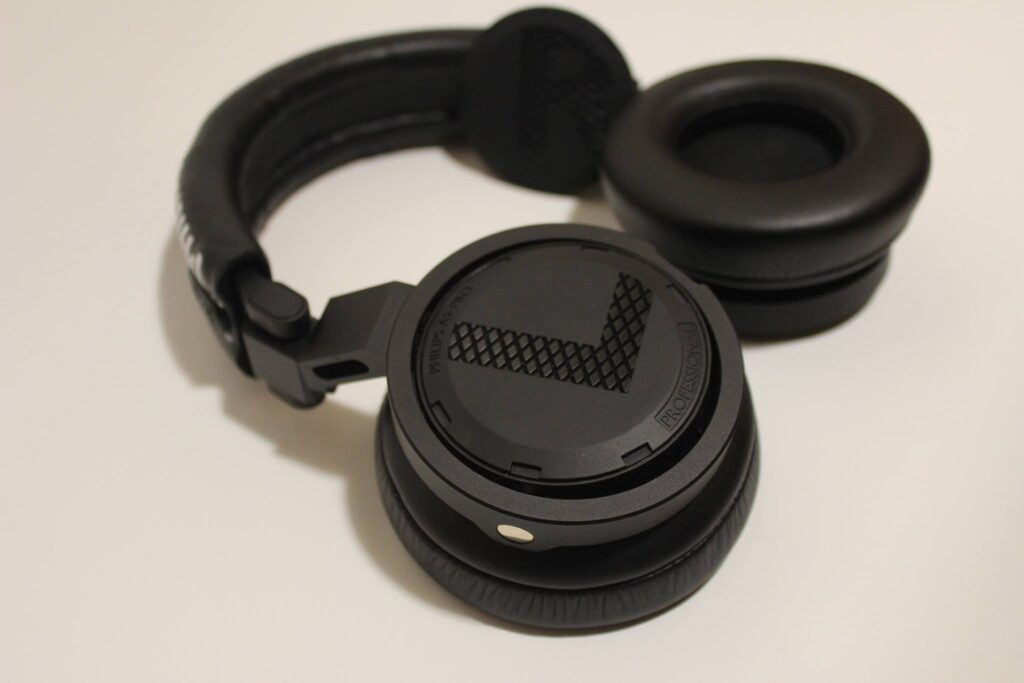
Binaural beats need two different frequencies arriving at each ear separately. Without headphones, both ears hear both frequencies, the beat disappears, and what is left is just a slightly detuned tone. So the short answer is: no, they do not survive a speaker — with one partial exception, explained below.
That is a physical constraint, not a matter of quality. The effect depends on your brain receiving 200 Hz on the left and 207 Hz on the right, and comparing them. A single speaker sends both to both ears. There is no processing trick that fixes this in the air.
What a binaural beat actually is
Play 200 Hz in the left ear and 207 Hz in the right. Each ear hears a steady tone. The auditory system, comparing the two, perceives a slow pulse at 7 Hz — the difference. That pulse is not present in the sound; it is generated in the hearing pathway.
Because the beat is constructed from the difference between channels, anything that mixes the channels destroys it. Speakers mix in the room. Mono mixes it in the file. A “binaural” track played on a phone speaker is, functionally, a single detuned tone.
The speaker exception: stereo with separation
Two speakers placed far apart, with your head equidistant and the room not too reverberant, preserve some channel separation. In practice you get a weak, unstable version of the effect — enough that some people report “something”, not enough to rely on. If you want to test it, sit exactly between the speakers, close your eyes, and move your head slowly. If the pulsing disappears when you move, you were hearing the room, not a binaural beat.
This is also why binaural tracks are a poor choice for sleep: you cannot keep your head still for eight hours, and headphones for eight hours are their own problem.
What the research does and does not show
Binaural beat studies are small and mixed. Some report changes in relaxation ratings or EEG measures; others find nothing beyond what a plain tone produces. What is consistently true is that the effect depends on channel separation — which is why “binaural beats on speaker” studies tend to be the ones that find nothing.
Treat binaural audio as a texture with a plausible mechanism, not a proven tool. If it relaxes you with headphones on, use it. If it does not, no amount of belief will make the beat appear on a speaker.
If you cannot wear headphones
Plenty of people cannot: side sleepers, people with ear canal sensitivity, anyone sharing a bed. The honest alternatives are not binaural — they are textures that work in a room:
- Slow amplitude movement. A pad or drone that swells and fades every few seconds gives a similar sense of movement without needing two channels. It is not a beat, but it fills the same role: something slow to rest your attention on.
- Filter sweeps. A lowpass that opens and closes slowly creates motion in the spectrum rather than in the stereo field.
- Wide stereo with phase differences. Two slightly detuned voices panned wide create a shimmer on speakers, which many people find as pleasant as a beat and rather more forgiving.
The space and ambient pillar is built mostly from these: drones, pads and slow filter movement, designed for speakers rather than headphones. The meditation pillar does the same with bowl and tanpura engines.
How to use binaural audio properly
- Use wired over-ear headphones. Bluetooth introduces its own latency and, on some codecs, channel processing.
- Keep the volume low — the beat is a difference signal and does not need level.
- Sit or lie still for the first ten minutes. Movement changes the interaural difference.
- Do not use it for sleep if you move a lot. Use a room-filling texture instead.
Common mistakes
- Playing a binaural track through a laptop. Laptop speakers are inches apart; the channels are effectively mono.
- Assuming “8D audio” is binaural. It is a panning effect, not a beat.
- Turning it up. Loudness does not strengthen the beat; it just makes the tones harder to ignore.
- Expecting a specific brainwave state. That claim is doing more work than the evidence supports.
What to do instead, by situation
Sharing a bed: a low speaker with a slow pad. Avoid anything with a strong pulse — it draws attention.
Side sleeper: one earbud is worse than none, because it unbalances the mix. Use a speaker, or accept mono and pick a texture that does not depend on stereo.
Focus at a desk: headphones are fine and the beat survives; but a steady broadband texture usually does more for concentration than a beat does, because it masks the office.
Tinnitus: binaural beats are not a masking tool. If you are trying to cover ringing, brown noise or rain does the job with far less structure.
Frequently asked questions
Do binaural beats work on AirPods?
Yes, as long as both channels reach the correct ear and spatial audio is off. Spatial audio can re-mix the channels, which is exactly what you do not want.
Can I get the effect with one earbud?
No. One ear cannot produce an interaural difference. You will hear a single tone.
Are binaural beats safe?
At low volume, listening is not considered risky. Skip them if you have a seizure disorder, and do not drive while using them.
If what you actually want is a room that stops interrupting you, browse the curated set and compare a binaural-style pad with a plain brown noise seed at the same volume. Most people discover the second one does more of the work.
More guides
- Nature Sounds vs White Noise for Focus White noise masks a room; nature sounds give attention somewhere to rest. Pick by what is…
- How Long Should a Sleep Sound Session Run? Five minutes to start, eight hours to stay asleep. Match the timer to the noise in…
- Why Looped Sleep Audio Starts to Annoy You A seam, a repeated dog, a trackable tone, or volume creep. Four reasons a sleep sound…